Compare
Wallet loyalty cards vs loyalty apps: which model does your business need?
There are three ways to put a loyalty program on a customer's phone: build your own app, join a shared loyalty app that many businesses use, or issue a card into Apple Wallet or Google Wallet. Each is the right answer for a different kind of business.
The short answer
- Wallet Loyalty Cards vs Loyalty Apps
- A dedicated app can be the better choice for brands with enough visit frequency, content and functionality to justify an install, such as ordering, payment or a large menu. A shared multi-brand app suits businesses whose customers already use that app. A wallet loyalty card suits the business that wants loyalty without asking the customer to install another standalone app. Loyal-T Cards is the wallet-card option.
Criteria
Loyalty app (dedicated or shared) vs Wallet loyalty card, criterion by criterion.
| Criterion | Loyalty app (dedicated or shared) | Wallet loyalty card (Loyal-T Cards) |
|---|---|---|
| What the customer installs | Your app, or a shared loyalty app | No separate Loyal-T Cards customer app; uses Apple Wallet or Google Wallet on a compatible device |
| Joining | Download, create an account, log in | Scan a QR code; the card is added to the wallet |
| At the counter | Open the app, log in if needed, show the screen | Open the wallet; the card is there |
| Whose brand the customer sees | Yours (dedicated) or the app's (shared) | Yours: a branded card |
| What it can do | Anything you build: ordering, payment, content, loyalty | Loyalty: stamps, points, membership, coupons, gift value, notifications |
| Cost | Development and maintenance (dedicated) or a subscription (shared) | US$660 per year for one location, setup included |
| Maintenance | App-store releases, OS updates, support | No custom customer app to maintain. Your team still manages the program, rules and staff workflow |
| Notifications | App notifications, if the customer allows them | Wallet notifications where configured, subject to device settings |
| Who runs it | Your developer or the app vendor | Loyal-T Cards sets it up; your staff run it with the scanner |
What the customer installs
Loyalty app (dedicated or shared)
Your app, or a shared loyalty app
Wallet loyalty card (Loyal-T Cards)
No separate Loyal-T Cards customer app; uses Apple Wallet or Google Wallet on a compatible device
Joining
Loyalty app (dedicated or shared)
Download, create an account, log in
Wallet loyalty card (Loyal-T Cards)
Scan a QR code; the card is added to the wallet
At the counter
Loyalty app (dedicated or shared)
Open the app, log in if needed, show the screen
Wallet loyalty card (Loyal-T Cards)
Open the wallet; the card is there
Whose brand the customer sees
Loyalty app (dedicated or shared)
Yours (dedicated) or the app's (shared)
Wallet loyalty card (Loyal-T Cards)
Yours: a branded card
What it can do
Loyalty app (dedicated or shared)
Anything you build: ordering, payment, content, loyalty
Wallet loyalty card (Loyal-T Cards)
Loyalty: stamps, points, membership, coupons, gift value, notifications
Cost
Loyalty app (dedicated or shared)
Development and maintenance (dedicated) or a subscription (shared)
Wallet loyalty card (Loyal-T Cards)
US$660 per year for one location, setup included
Maintenance
Loyalty app (dedicated or shared)
App-store releases, OS updates, support
Wallet loyalty card (Loyal-T Cards)
No custom customer app to maintain. Your team still manages the program, rules and staff workflow
Notifications
Loyalty app (dedicated or shared)
App notifications, if the customer allows them
Wallet loyalty card (Loyal-T Cards)
Wallet notifications where configured, subject to device settings
Who runs it
Loyalty app (dedicated or shared)
Your developer or the app vendor
Wallet loyalty card (Loyal-T Cards)
Loyal-T Cards sets it up; your staff run it with the scanner
When a dedicated app is the right call
If customers visit often and your app does more than loyalty, an install is justified. Ordering ahead, paying in the app, a large menu, booking, content worth returning to: those give the customer a reason to keep the app. Loyalty becomes one feature inside it. Building and maintaining an app is expensive and slow, and for a single-location business it is usually out of proportion, but for the right brand it is the stronger product.
When a shared loyalty app makes sense
A multi-brand loyalty app pools many businesses in one download. If your customers already use it, joining is easy for them. The trade-off is that your card sits in someone else's app, next to other businesses' cards, and the customer relationship runs through that app's account. Stamp Me is the best-known example in this category.
When a wallet card fits
A wallet card lets a customer keep your branded loyalty pass in Apple Wallet or Google Wallet on a compatible device. The customer follows your join link or QR code and adds the issued card. Your business does not need a separate customer app for this workflow. Payment, ordering and loyalty recording remain distinct.
Loyal-T Cards is a wallet-card platform. It prepares the branded card, configures the loyalty structure with you and onboards your team. Staff record visits with the scanner; nothing is synchronised with a POS or ordering app.
Decision
Which one is right for your business?
A loyalty app may be the better choice if
- Your customers visit often enough, and use enough features, to justify installing an app
- You need ordering, payment or content alongside loyalty
- Your customers already use a shared loyalty app at other businesses
A wallet card may be the better choice if
- You want loyalty without asking customers to install another standalone app
- You want your own branded card rather than a listing in someone else's app
- You want no custom customer-app development or app-store release process
- You want the program configured and launched for you at a published annual price
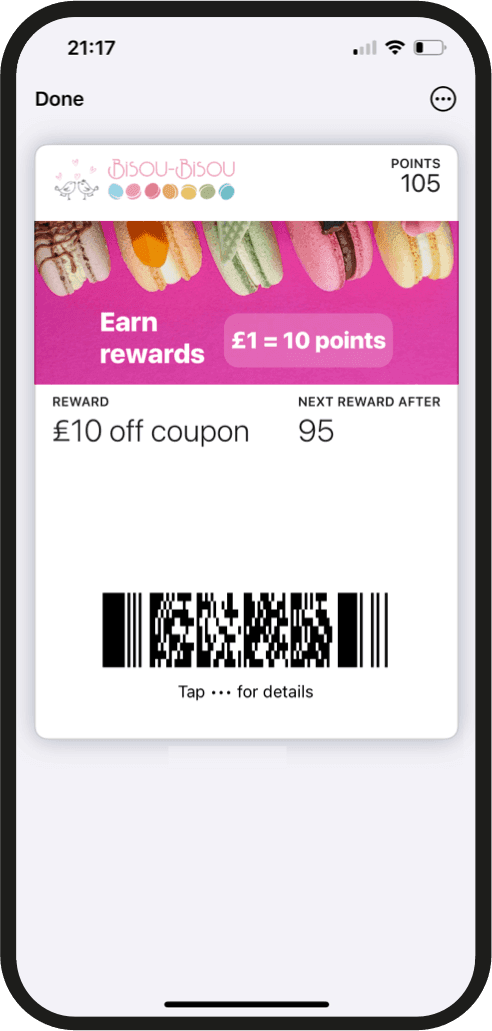
Rewards Card
Customers earn points or rewards according to configured rules, so different purchases or actions can earn different amounts.
Loyal-T Cards pricing
US$660/year
Loyal-T Cards Annual: one business location, annual billing, platform setup, branded Apple Wallet and Google Wallet card, initial loyalty structure, QR materials and team onboarding included.
Founding 20First 20 businesses: US$330 for the first year, then US$660/year from year two.
Payment may be shown in your local currency at checkout.
Common questions
Loyal-T Cards
We set it up. Your team runs it.
If a wallet loyalty card is the right model for your business, the pricing page shows the whole annual plan. If you would rather ask a person first, WhatsApp us.
First 20 businesses: US$330 for the first year, then US$660/year. Payment may be shown in your local currency at checkout.