Compare
Digital vs physical loyalty cards: how to decide.
Physical loyalty cards come as paper, cardboard, plastic and key fobs. They all depend on the customer carrying them. A digital wallet card depends on the customer carrying a phone. That single difference drives most of the comparison.
The short answer
- Digital vs Physical Loyalty Cards
- A physical loyalty card is the right choice when you want something tangible, cheap and free of technology, or when your customers do not carry compatible phones. A digital wallet card is the right choice when you want the card present at every visit, updatable without reprinting, and backed by a record of who comes back. Loyal-T Cards is the digital option with the setup included.
Criteria
Physical card (paper, plastic, fob) vs Digital wallet card, criterion by criterion.
| Criterion | Physical card (paper, plastic, fob) | Digital wallet card (Loyal-T Cards) |
|---|---|---|
| Presence at the counter | Only if the customer brought it | On the phone the customer carries |
| Tangibility | Something to hold; a small branded object | A branded pass on a screen |
| Production cost | Per card: paper is cheap, plastic and fobs cost more | No per-card cost |
| Platform cost | None for paper; a system if plastic cards are scanned | US$660 per year for one location, setup included |
| Updating design or reward | Reprint or reissue | Update in the platform; refreshes on phones |
| Data | None for paper; some if plastic cards are scanned into a system | New and repeat visits, redemptions, loyalty revenue in the dashboard |
| Communication | None | Wallet notifications where configured |
| Waste | Printed and plastic cards are discarded | No physical card |
| Customer requirement | Carry the card | A compatible smartphone |
Presence at the counter
Physical card (paper, plastic, fob)
Only if the customer brought it
Digital wallet card (Loyal-T Cards)
On the phone the customer carries
Tangibility
Physical card (paper, plastic, fob)
Something to hold; a small branded object
Digital wallet card (Loyal-T Cards)
A branded pass on a screen
Production cost
Physical card (paper, plastic, fob)
Per card: paper is cheap, plastic and fobs cost more
Digital wallet card (Loyal-T Cards)
No per-card cost
Platform cost
Physical card (paper, plastic, fob)
None for paper; a system if plastic cards are scanned
Digital wallet card (Loyal-T Cards)
US$660 per year for one location, setup included
Updating design or reward
Physical card (paper, plastic, fob)
Reprint or reissue
Digital wallet card (Loyal-T Cards)
Update in the platform; refreshes on phones
Data
Physical card (paper, plastic, fob)
None for paper; some if plastic cards are scanned into a system
Digital wallet card (Loyal-T Cards)
New and repeat visits, redemptions, loyalty revenue in the dashboard
Communication
Physical card (paper, plastic, fob)
None
Digital wallet card (Loyal-T Cards)
Wallet notifications where configured
Waste
Physical card (paper, plastic, fob)
Printed and plastic cards are discarded
Digital wallet card (Loyal-T Cards)
No physical card
Customer requirement
Physical card (paper, plastic, fob)
Carry the card
Digital wallet card (Loyal-T Cards)
A compatible smartphone
The case for a physical card
A physical card is tangible. Some businesses like handing over a small branded object, and some customers like receiving one. Paper is cheap enough to give away without thought. None of it needs a phone, a signal or an explanation, and no subscription is involved.
The case for a wallet card
A wallet card is present whenever the phone is, which is nearly always. It updates when you change the reward or the design. It records the visit when staff scan it, so the business can see how much of its trade is repeat and which rewards are redeemed. And it can carry a notification, where you configure one, to a customer who has not been in for a while.
It is not automatic and it is not integrated with your till: a staff member scans the card, and that scan is the record.
The environmental point, kept in proportion
A digital card produces no printed or plastic waste. That is a real but modest advantage for a single business, and it should not be the reason you choose one over the other. Choose on presence, data and workflow, and take the reduced waste as a side benefit.
Decision
Which one is right for your business?
A physical card may be the better fit if
- You want something tangible to hand over
- Your customers do not carry compatible phones
- You want no subscription and no technology
A digital wallet card may be the better fit if
- Cards are forgotten or lost and programs go unfinished
- You want to update the card without reprinting
- You want to know who comes back and how often
- You want the card prepared and your team onboarded for you
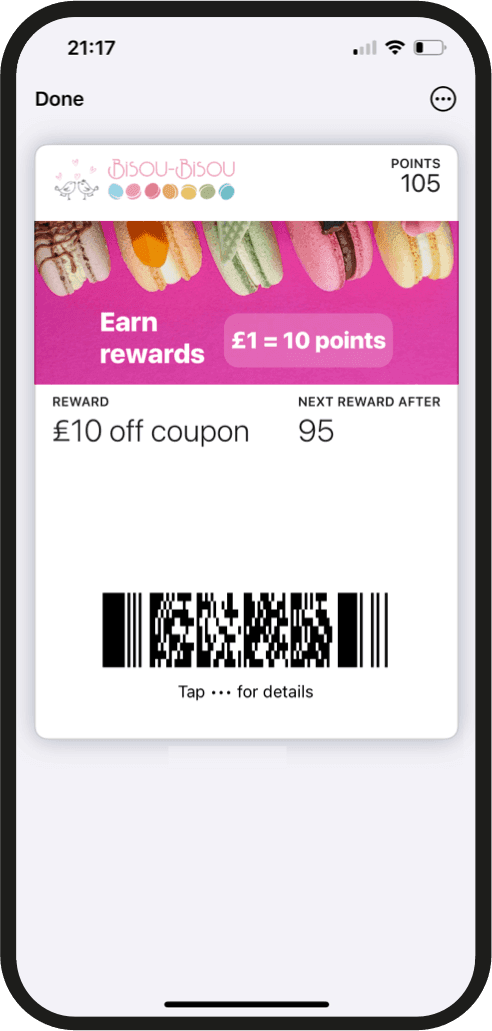
Rewards Card
Customers earn points or rewards according to configured rules, so different purchases or actions can earn different amounts.
Loyal-T Cards pricing
US$660/year
Loyal-T Cards Annual: one business location, annual billing, platform setup, branded Apple Wallet and Google Wallet card, initial loyalty structure, QR materials and team onboarding included.
Founding 20First 20 businesses: US$330 for the first year, then US$660/year from year two.
Payment may be shown in your local currency at checkout.
Common questions
Loyal-T Cards
We set it up. Your team runs it.
If a wallet loyalty card is the right model for your business, the pricing page shows the whole annual plan. If you would rather ask a person first, WhatsApp us.
First 20 businesses: US$330 for the first year, then US$660/year. Payment may be shown in your local currency at checkout.